

Looking for a physiotherapy clinic near me often starts with a practical problem: back pain at your desk, a knee that hurts on stairs or an injury keeping you away from sport. You need to understand what is wrong and what to do next.
To compare the best physiotherapy clinics in Pakistan, look beyond a ranking headline. Whether you are considering a physiotherapist in Karachi, Lahore or Islamabad, ask about assessment, relevant qualifications, treatment goals and costs. This RDPC guide explains those checks and introduces our physiotherapy department in DHA Karachi.
01 / Start with your reason for visiting
What can a physiotherapy clinic help with?
Physiotherapy, also called physical therapy, supports movement, function and rehabilitation. Care may combine exercise, advice and hands-on techniques, depending on your assessment. It can complement medical or surgical care when needed. [1]

Back pain, sciatica & neck pain
Assessment may address lower-back pain, symptoms described as a slip disc, or neck stiffness associated with cervical spondylosis. Your symptoms and examination guide the next step.

Joint pain & everyday movement
Knee arthritis, frozen shoulder, tennis elbow and plantar fasciitis can affect daily tasks. Discuss how to improve function, manage activity and work towards realistic goals.

Sports injury rehabilitation
Ankle sprains, hamstring strains and ligament injuries need a plan matched to the injury and sport. Ask how strength, movement and readiness to return will be assessed.

Post-surgery physiotherapy
Rehabilitation after knee or hip replacement, fracture surgery or ligament reconstruction should follow the surgical team’s precautions. Bring your discharge notes and recovery instructions.

Stroke & neurological rehabilitation
Recovery goals may include walking, balance and everyday tasks. Ask whether the clinician has experience with your needs and how care will coordinate with the wider rehabilitation team.

Balance, walking & mobility
Balance training and gait rehabilitation can form part of care for reduced mobility. Discuss falls, walking aids, home access and the activities you most want to regain.
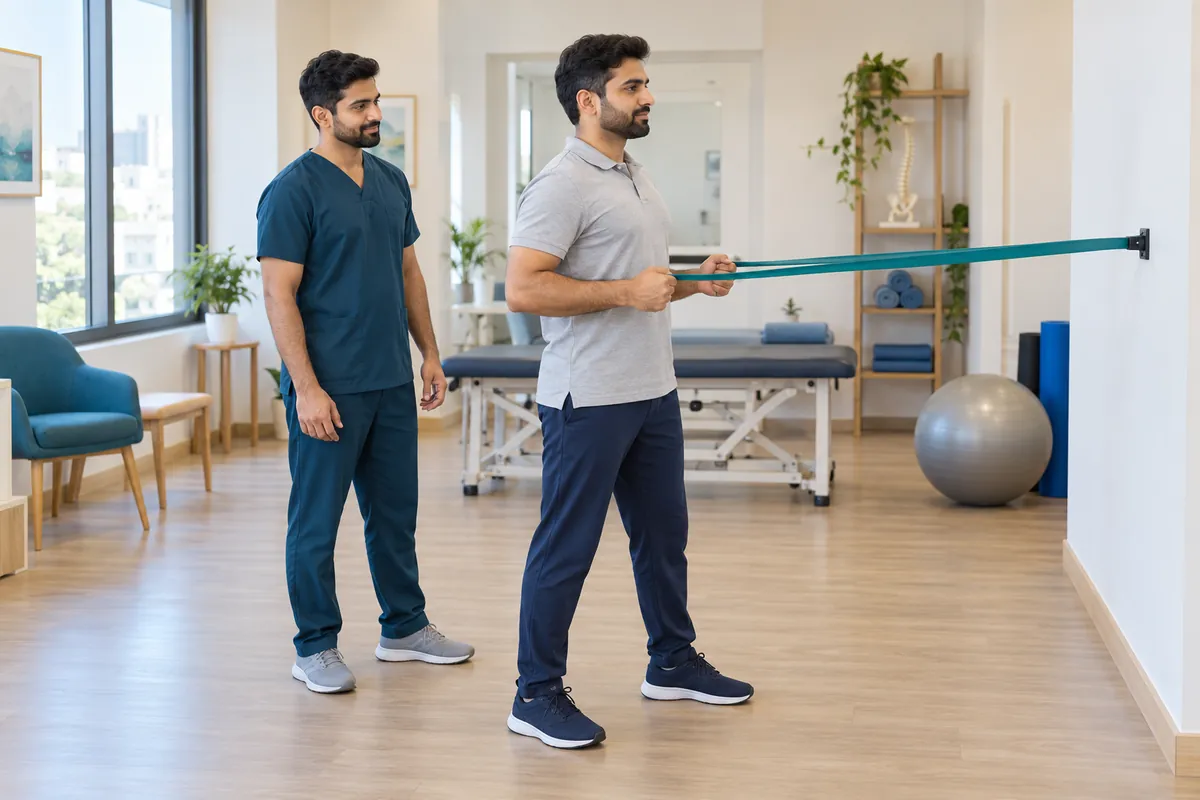
Treatment-area pictures are AI-generated illustrations, not RDPC patients, staff or results. They do not show an exercise prescription.
02 / Choose the right next step
When should you see a physiotherapist?
Arrange an assessment when pain keeps returning, stiffness limits normal tasks, or a sports injury is not improving. Weakness or reduced mobility after surgery or illness also deserves a clear rehabilitation plan. You do not need to wait for a fixed number of weeks before asking for help.
Pain spreading into an arm or leg, especially with new numbness or weakness, needs assessment to decide whether physiotherapy or medical care should come first.
Some back-pain symptoms need urgent medical care
Go to an emergency department immediately for back pain with new loss of bladder or bowel control, numbness around the genitals or anus, or weakness or numbness in both legs. Back pain following a serious accident also needs emergency assessment.
Seek prompt medical advice for fever or feeling unwell with back pain, severe rapidly worsening pain, or unexplained weight loss. [2]
03 / Understand the treatment names
Physiotherapy treatments and techniques explained
A long treatment menu is less useful than an explanation of why a particular approach suits your problem. Ask what each technique is meant to achieve, what the alternatives are and how progress will be reviewed.
Exercise therapy & manual therapy
Exercise therapy can include strengthening, mobility and balance work. Manual therapy uses hands-on techniques such as joint mobilisation or soft-tissue work. For low-back pain, NICE recommends considering manual therapy only within a package that includes exercise. [3]
TENS therapy & ultrasound therapy
These equipment-based approaches are sometimes grouped under electrotherapy. Their value depends on the condition; they should not automatically be added to every appointment. Ask what evidence supports their use for your diagnosis and what benefit would justify continuing them.
Acupuncture, dry needling & cupping
Acupuncture and dry needling use fine needles, but their approaches differ. Discuss suitability, expected benefits and risks such as soreness, bruising or bleeding before agreeing. [4] Cupping uses suction on the skin. Evidence for pain relief is limited, and bruising-like marks, burns or infection can occur. [5]
Chiropractic care & spinal manipulation
Spinal manipulation applies a controlled thrust to a joint and may be part of chiropractic care. Ask about the practitioner’s qualifications, screening, potential benefits and risks. Any hands-on option should fit into an agreed plan, with suitable alternatives discussed. [6]
Kinesio taping & traction therapy
Ask what a proposed tape or traction treatment is intended to change, how long it will be tried and how its effect will be measured. Availability does not establish suitability, and neither should replace a diagnosis and a purposeful rehabilitation plan.
For low-back pain with or without sciatica, NICE advises against traction, acupuncture, ultrasound, TENS and interferential therapy. These recommendations are specific to that condition. Ask your clinician to explain the evidence relevant to your own problem. [3]
Your home exercise programme
Ask for exercises you understand, an agreed starting level and instructions for adjusting or stopping an activity if symptoms change. Make the plan workable around your home, job and daily routine, and tell your physiotherapist if it is difficult to follow.
04 / Compare the complete cost
Physiotherapy fees in Pakistan: what should you ask?
Physiotherapy costs vary with the city, clinic, appointment type and rehabilitation needs. A consultation price may cover an assessment only; it does not necessarily include treatment, follow-up visits or a home visit.
Oladoc’s DHA Karachi physiotherapist listings advertise a consultation-fee range of Rs. 1,700–3,000, checked on 10 November 2026. This is a platform listing range, not a national average or the price of a complete treatment plan. Confirm the current fee directly with the clinic. [7]
| Cost to check | Ask the clinic | Why it matters |
|---|---|---|
| First assessment | Does the fee include examination, advice and treatment? | Consultation and treatment charges may be separate. |
| Follow-up sessions | What is the session length, fee and review schedule? | Compare the same type of appointment. |
| Home physiotherapy | Is my area covered, and is travel charged separately? | Availability and travel costs can vary. |
| Packages & extras | What is included, and what happens if the plan changes? | Understand payment and cancellation terms before committing. |
The number of physiotherapy sessions depends on your assessment, goals and progress. A minor injury, long-standing symptoms and post-surgical rehabilitation will not share one timetable. Ask when the plan will be reviewed rather than relying on a guaranteed number of visits.
Ask RDPC about assessment fees05 / Arrive prepared
What happens at your first physiotherapy appointment?
Bring any relevant reports, scans, surgery notes and a list of medicines. Note when symptoms began, what makes them better or worse and which activities matter most to you. A first visit commonly includes the following. [1]
-
A conversation about you
Discuss symptoms, health history, daily routine and your main goal—such as sleeping better, walking further or returning to work.
-
A movement assessment
The physiotherapist may assess movement, strength and function, explain the examination and ask for your consent.
-
An explanation and a plan
Ask what the findings suggest, whether another assessment is needed, and which treatment options are reasonable for you.
-
Advice for the days ahead
Leave knowing what to do at home, what changes to report and when to return for a progress review.
06 / Choose for your needs
How to choose the right physiotherapy clinic near you
A useful comparison looks at the clinician and the care process. Use these questions whether you want sports physiotherapy, post-surgery rehabilitation or help with a persistent movement problem.
-
Relevant qualifications
Ask for the treating clinician’s name, recognised physiotherapy qualification—such as a DPT—and current professional registration details.
-
Experience with your condition
Discuss the clinician’s experience with your type of injury or rehabilitation. Ask whether another professional should be involved.
-
A plan you understand
Look for clear goals, a home programme and progress reviews. Ask what happens if treatment is not helping.
-
Practical access
Check travel, steps or lift access, appointment duration, fees and evening or Sunday availability. Follow-up needs to fit your life.
Some patients need an orthopaedic or other medical opinion. Ask how referrals are arranged; a scan is not automatically needed for every pain problem. The best fit is a clinic that explains its limits as clearly as its services.
07 / Meet your physiotherapy lead
Dr. Laheem Hassan, Head of Physiotherapy at RDPC

Head of Physiotherapy
DPT · MPhil in Musculoskeletal Physical Therapy
Movement, function & rehabilitation
Dr. Laheem Hassan leads RDPC’s physiotherapy department. His clinic-reported background includes musculoskeletal rehabilitation, sports injury care and manual therapy, with chiropractic care and acupuncture among the approaches discussed according to assessment.
Tell him what you want to return to doing, and ask how the proposed plan will measure progress. Review his qualifications and professional background before booking.
Read Dr. Laheem’s full profile08 / Physiotherapy in DHA Karachi
Visit Rajput Dental & Physio Clinic
RDPC offers physiotherapy, chiropractic care, cupping and acupuncture, alongside orthopaedic consultation. Explore our physiotherapy services and ask which clinician and approach suit your needs. Treatment choice follows assessment.
Find us in DHA Phase II Extension
Near Blue Ribbon Bakery
Shop 60E, 21st Commercial Street,near Blue Ribbon Bakery,
DHA Phase II Extension,
Karachi 75500. Directions & contact details
Plan your visit
Open 7 Days · 2 PM–9 PM
Confirm Dr. Laheem’s appointment availability, including evening or Sunday visits, before travelling.
Call 03193403700For home physiotherapy, a female physiotherapist or access requirements, ask about current availability when booking.
If you are searching for a physiotherapist in DHA Karachi, consider the journey for follow-up visits as well as the first appointment. Our DHA physiotherapy guide provides more local planning information.
Your questions, answered
FAQs about visiting a physiotherapy clinic
Is physiotherapy painful?
Some assessment movements or techniques may be uncomfortable. Tell your physiotherapist during the session and ask what response to expect afterwards. Report new, severe or worsening symptoms so the plan can be reassessed.
Do I need a doctor’s referral for physiotherapy?
Ask the clinic about its booking requirements. A direct assessment may be available, but your symptoms, surgery instructions or insurer may require medical referral or clearance. Bring any relevant records.
Can I get physiotherapy at home in Karachi?
Ask whether a home visit is available for your location and rehabilitation needs. Confirm the clinician, visit length, travel charge and any equipment or caregiver support required. RDPC’s current home-visit availability should be checked directly.
Can I request a female physiotherapist?
Yes, you can state this preference when enquiring. Confirm that an available clinician has the experience needed for your concern, especially for pelvic health or post-pregnancy care, and agree on the appointment before travelling.
What should I wear to a physiotherapy appointment?
Wear comfortable clothing that allows movement and access to the area being assessed. Ask beforehand if you are unsure. You can discuss privacy, draping or a chaperone with the clinic.
How many physiotherapy sessions will I need?
There is no reliable fixed number before assessment. Your condition, goals, other health needs and progress affect the timetable. Ask for an initial plan and a review point, then discuss whether to continue, adjust treatment or seek another opinion.
Which is the best physiotherapy clinic in Pakistan?
No single clinic is the best match for every patient. Compare relevant qualifications, experience, assessment quality, clear fees and practical follow-up. This clinic-published guide offers selection criteria, not an independent national ranking.
Take the next step with a clear plan
Tell us what is getting in the way.
Arrange a physiotherapy assessment at RDPC. Share your main concern and ask about the appropriate clinician, current fee and available time.
DHA Phase II Extension · Open 7 Days · 2 PM–9 PM
Sources & editorial notes
Updated 10 November 2026. Published by Rajput Dental & Physio Clinic. General information supports an individual assessment. Clinician qualifications and clinic services are reported by RDPC; fees from external listings are identified separately.
- NHS: physiotherapy and what happens at an appointment.
- NHS: back pain and symptoms needing urgent help.
- NICE NG59: low-back pain and sciatica recommendations. Condition-specific clinical guidance.
- NHS Fife: acupuncture and dry needling.
- NCCIH: cupping evidence and safety.
- NCCIH: spinal manipulation.
- Oladoc: physiotherapist consultation listings in DHA Karachi. Range checked 10 November 2026; confirm current charges.
- RDPC: Dr. Laheem Hassan’s professional profile.
Join the conversation
Questions & comments
Comments are public. For appointments or personal medical information, contact the clinic directly.